Zhang Yimou’s Hero as discourse of national identity
Its imagination of Chinese nation for domestic and foreign audiences
¯¯¯¯¯¯¯¯¯¯¯¯¯¯¯¯¯¯¯¯¯¯¯¯¯¯¯¯¯¯¯¯¯¯¯¯¯¯¯¯¯¯¯¯¯¯¯¯¯¯¯¯¯¯¯¯¯¯¯¯¯¯¯¯¯¯¯¯¯¯¯¯¯¯¯¯¯¯¯¯
Ioannis Tsirkas
‘As Benedict Anderson has argued, nations are “imagined communities”. That is, they are constituted in part by the discourses that define nation-ness, what we might call discourses of national identity. These are the stories that all nations tell themselves: stories about the nation’s origins, its struggles, its triumphs, its character, its values, its past, and even its future.’ (Hogan 2010, p.63)
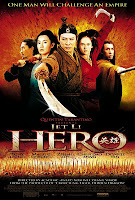
Zhang Yimou’s Hero (China, 2002) is indeed a film in which we can locate all these things about China that Jackie Hogan mentions in the above quotation and therefore it can be seen and examined as a discourse of China’s national identity. In this paper I will try to discuss the afore-mentioned subject by analyzing the main heroic character of the film, Nameless (Jet Li), as indicator of a suggested political attitude towards Chinese’s nation or the concept of nation in general after demonstrating how such an attitude sets off the action of the film. Through this it will be reflected that Hero does not only make do with creating an image about Chinese’s national identity, but also that its text seems to suggest a particular way of such a conception. In addition, as a film that aimed and succeeded to rise to prominence as a global blockbuster it raises questions about the possible fluctuation of covetable acceptance it carried off between the domestic and foreign audiences. Thereafter, I will focus on its suggested political stasis to the notion of Chinese nation for it consists an essential factor for the amplification of the film’s globality, since we can consider the in question suggestion by applying the notion of nation in general, functioning thus as a common point of interest among its multiple audiences.
From the images of national heroes to the image of Chinese nation
The (re)production of heroic characters in Hero is entailed by the (re)construction of Chinese national identity illustrating comparatively a national and by extension nationalist complexion and substantiating pursuance for ‘identity, unity and collective vitality’ (Guo 2010, p.27). The recourse for these characters/figures and for the whole concept of the film to the historical past, which reflects upon a ‘powerful, peaceful and united China in the present’ (Berry and Farquhar 2006, p.166) functioning as a contemplating comment on it (Hunt 2011b, p.68), is a device quite usual in Chinese culture (Berry 2009, p.116). The choice of wuxia genre, a China’s national product (Teo 2012, p.297), although is connected with ‘spiritual resistance to the officially-constructed discourse of nationalism’ (Quiong Yu 2012, p.161) functions here as parable, or even justification (Curtin 2012, p.193), of the ‘political and cultural nationalism’ (Chan 2011, p.152) of China electing it as a totalitarian nation of negative excesses (Teo 2009, p.187). However, if Hero represents certain anxieties of a redeemed through authoritarianism contemporary Chinese society (Xu 2007, p.30) in what extent is reputed as a global film and in which ways is able to talk to foreign audiences?
Hero’s narrative although is based upon an alternative version of a foundational Chinese myth lends itself in ‘multiple readings in various contexts locally and globally’ (Lee 2007). Although some composite Chinese elements and the conspicuous ‘nationalist imperative’ (Chan and Fung 2010, p.200) can be identified in the film, simplifying any historical complexity, avoiding ‘anything too “Chinese”’ that might confuse’ (p.206) the foreign audiences and following the ‘demands of the global market’ (p.200) in general, Hero succeeds to balance ‘between a progressive Chinese nationalism and [the] western modernity’ (Hunt 2011a, p.147). The basic key of this achievement appears latent into the deliberate and precise discrimination in the use of the film’s narrative and images. On a first level, the committed propagandistic narrative seems to apply to the domestic audience while the seeking for representative impressive images to the foreign one. On a second level, both of them can be adaptable to each nation of the foreign audiences and most importantly to function as an indeterminate ‘globalised propaganda’ (Harrison 2006, p.572) of loyalty to an authoritarian rule. Consequently, Hero is not only a ‘film of images’ (Gillespie 2004, cited in Qiong Yu 2012, p.156), but also an artistic presumptive evidence of established images, heroic and national ones and more specifically idealized ways of seeing and perceiving the notion of nation.
Nameless as national hero
The film starts with the following three in order of appearance inscriptions: ‘People give their lives for many reasons.’[1], ‘For friendship, for love, for an ideal’[2], ‘And people kill for the same reasons…’. Consequently, we are able to presume from the beginning that we will watch a kind of sacrifice (giving of lives) opposed to a converse one (killing lives). Possibly we will have to identify ourselves with the characters who will perform these sacrifices. The following inscription tells us: ‘Before China was one great country, it was divided into seven warring states.’ leaving us to assume that these sacrifices will be for China. After that, the following inscriptions inform us about a ‘vision’ of the ‘ruthless ruler’ of the Kingdom of Qin (Chen Daoming) to ‘unite the land’ putting an end to the war of the states. His ‘idea’ is being characterized as ‘soaked in the blood of his enemies’. Maybe this idealist ruthless ruler will be one of the two possible sacrificing characters. The last inscription before the appearance of the title of the film is: ‘In any war there are heroes on both sides…’. In this way the King of Qin appears implicitly as hero from the beginning, a national one. What we have to wait for is the appearance of the hero of the other side. As we will realize in the end of the film there is not actually a veritable other side. Nameless, the one representing the main impersonative character, will sacrifice himself for the king’s idea of the China’s national unification becoming also a hero, signifying that heroes are the ones who sacrifice the lives of others or the lives of themselves in the name of nation.
Therefore we are not surprised when the other main character of the film introduces himself as Nameless. Sacrificing yourself in the name of nation means that you lose your identity, that you understand your own insignificance compared to the significance of the nation. Furthermore, his self-introducing through his off-screen voice marks him as narrator of what will follow forcing us to identify ourselves with him[3]. We will have to accept his future (self-)sacrifice[4] as ours too. His will to assassinate the King is something that will be revealed later in the plot, despite his unanticipated decision to let him live very near to the end of the film. Thereafter, until this turning point of the plot we are watching what we faulty consider as the heroic fights of an obedient to the King assassin in order to ensure the integrity of the continuation of his life and reign[5]. Until then we are identified with an individual person who fights and kills because, as he confess in the beginning, this was the obvious fate for somebody without a family name. When we learn his real purpose we admire him yet more, not only as a masculine male figure who offers visual pleasure through the perfection of his body[6], but as a determined moral man to the defense of the small kingdom from which he derives his origin too. He is not an individual, but a votary of his small kingdom who fights for his need to resist against the extinction which threatens it. In order to consider him as a real hero he has to become a votary of his nation.
The true indicator of China’s nation is nevertheless the King. A despotic and imperialist ruler. The time when Nameless lets him live announces that its a decision whereby ‘many will die’ apart from him. Due to the expansion of the nation the differences have to be erased and this will happen by the route of violence (Quiong Yu 2012, p.161) which is considered by the presented as visionary, perceptive and fearless King (Guo 2010, p.34) inevitable. For the domestic audience this concentration of power in the King (Larson 2008, p.182) and the ignoring of ‘cultural diversity and individual rights’ (Yuelian 2003, cited in Quiong Yu 2012, p.154) can be reflected into the present of China as a glorification of the national interest and even more as an exhortation to it[7]. The foreign audience is free to adapt the film’s suggested political attitude to nationalism to its own conditions, or to consider Chinese nation as an antagonistic one willing puissance in the contemporary global order, or to content themselves only to the film’s visual pleasures just enriching their images about China as a ‘culturally rich country’ (Larson 2008, p.185) and a developing powerful nation of imposingness.
Conclusions: considering Jhang Yimou as national hero
At the end of the film on a shot of the Great Wall a text like the one in the beginning is appearing again affirming the director Jhang Yimou as ‘principal narrator’ (Rawnsley 2010, p.15) of Hero. In these lines we read that the King’s vision to ‘unite’ the country was achieved and that the Chinese still advert the Great Wall, which he built two thousand years ago, when they speak about their country. The presence of this monument seems to consist an ‘intersection between China’s civilized past and modernized present’ (Xu 2007, p.60) confirming Yimou’s will to explore the appropriate political stasis of a Chinese to his nation in the present through a reversion to its origin and creation. As the Great Wall is a symbol of Chinese past grandiocity, in the same way he endeavored to make Hero a symbol of the potential resplendence of the contemporary Chinese nation. By succeeding to create a global blockbuster able to represent China to the western audience he becomes a kind of national hero for the Westerns, imposing thus the same status in his country (Chan and Fung 2010, p.209). If yet we consider Nameless as an alter ego of Yimou, who is being represented through the character of the King?
Regarding the King as the equivalent of the Chinese Communist Party, the political message of the film seems structured with preciseness. In this way and as my analysis demonstrated, Hero functions more as an intervention on the discourse about the expedient political stasis in the contemporary configuration of Chinese nation and as an imposing image to the West of its potential developing supremacy if this stasis will be adopted by the Chinese people, than just a cinematically cultural approach to the Chinese nation. Like Nameless, Yimou sacrificed his more artistic intentions and directions of the past in order to direct a high-budjet commercial film which applies to the masses inducing them to think and act nationally sacrificing their individualism like he did with his artistic one. Through Hero he is expressing primarily a covetable nationalism subservient to the political aspirations of the Communist regime and not the opposing doubts of his previous films for which he had experienced factual objections.
The perception of the Chinese audience, critics and scholars was the predictable[8], while the global audience even if apprehended the nationalist message, the overshadowing dominance of the film’s spectacle did not allow its taking objection to it. Although it would be illustrative to substantiate this reading of the film with Zhang Yimou's posterior route, my purpose was to count only to the film's text in which the transitional anguish of him and the Chinese nation is thoroughly reflected.
_______________________________________
[1] I will emerge presently the reason why I am keeping the original punctuation within the quotation marks.
[2] The symbol of full stop is absent in this sentence possibly in order to give emphasis both to the significance and the abstractness of the last world “ideal” pre-declaring that the film will be about ideals.
[3] His anomia also prompts our identification.
[4] It will be made clear later why his sacrifice has not to be considered as merely one of his own life.
[5] When the King asks him about a desirable reward for his achievement he responds that the integrity of Qin is his duty so laying down the only principle of his assassinations.
[6] It is worth mentioning that the construction of male images in the Chinese waxia genre films is being conducted by ‘strong nationalist overtone’ (Quiong Yu 2012, p.146).
[7] The assertion that the film’s narrative can function as ‘ideological endorsement to China’s ambitions to unify regional territories’ (Chaudhuri 2005, p.98) has not to be regarded as a far-fetched conclusion.
[8] It would be useful here to cite the following extract in order to give a concise idea of the film’s main reception in China: ‘Released at a time when China’s image was improving in the wake of continuous economic growth, entry into the WTO, winning the Olympic bid and the return of Hong Kong and Macau, Hero and the ensuing debate became part of the discourse on nationalism, and the movie was denounced as a vehicle for strengthening dictatorial rule because of its positive portrayal of the First Emperor’ (Louie 2008, p.137). The general endorsement of the film by China’s leaders (Berry and Farquhar 2006, p.163) is also indicating.
References
Berry, Chris and Farquhar, Mary (2006) China on Screen: Cinema and Nation. New York: Columbia University Press.
Berry, Chris (2009) ‘Jia Zhangke and the Temporality of Postsocialist Chinese Cinema: In the Now’, in Khoo, Olivia and Metzger, Sean (ed.) Futures of Chinese Cinema: Technologies and Temporalities in Chinese Screen Cultures. Bristol and Chicago: Intellect, pp. 111-128.
Chan, Joseph M. and Fung, Anthony (2010) ‘Towards a Global Blockbuster: The Political Economy of Hero’s Nationalism’, in Rawnsley, Gary D. and Rawnsley, Ming-Yeh T. (ed.) Global Chinese Cinema: The Culture and Politics of Hero. London: Routledge, pp. 198-211.
Chan, Kenneth (2011) ‘The Contemporary Wuxia Revival: Genre Remaking and the Hollywood Transnational Factor’, in Lim, Song Hwee and Ward, Julian (ed.) The Chinese Cinema Book. Basingstoke: Palgrave Macmillan, pp. 150-157.
Chaudhuri, Shohini (2005) Contemporary World Cinema: Europe, the Middle East, East Asia and South Asia. Edinburgh: Edinburgh University Press.
Curtin, Michael (2012) ‘Chinese Media Capital in Global Context’, in Zhang, Yingjin (ed.) A Companion to Chinese Cinema. Chichester: Wiley-Blackwell, pp. 179-196.
Guo, Yingjie (2010) ‘Recycled Heroes, Invented Tradition and Transformed Identity’, in Rawnsley, Gary D. and Rawnsley, Ming-Yeh T. (ed.) Global Chinese Cinema: The Culture and Politics of Hero. London: Routledge, pp. 27-42.
Harrison, Mark (2006) ‘Zhang Yimou’s Hero and the Globalisation of Propaganda’, Millennium: Journal of International Studies, 34, pp. 569-572
Hogan, Jackie (2010) ‘Gendered and Racialised Discourses of National Identity in Baz Luhrmann’s Australia’, Journal of Australian Studies, 34(1), pp. 63-77.
Hunt, Leon (2011) ‘Dragons Forever: Chinese Martial Arts Stars’, in Lim, Song Hwee and Ward, Julian (ed.) The Chinese Cinema Book. Basingstoke: Palgrave Macmillan, pp. 141-149.
¯¯¯¯¯¯ (2011) ‘Heroic Chivalry, Heroic Sacrifice: “Martial Arthouse” as Epic Cinema’, in Burgoyne, Robert (ed.) The Epic Film in World Culture. New York and London: Routledge, pp. 63-81.
Larson, Wendy (2008) ‘Zhang Yimou's Hero: Dismantling the Myth of Cultural Power’, Journal of Chinese Cinemas, 2(3), pp. 181-196.
Lee, Vivian (2007) ‘Into/Out of the Critical Divide: The Indeterminacy of Hero’, Scope, 9. [Online] Available at: http://www.scope.nottingham.ac.uk/article.php?issue=9&id=955 (Accessed 28 April 2013).
Louie, Kan (2008) ‘Hero: The Return of a Traditional Masculine Ideal in China’, in Berry, Chris (ed.) Chinese Films in Focus II. Basingstoke: Palgrave Macmillan, pp. 137-143.
Qiong Yu, Sabrina (2012) Jet Li: Chinese Masculinity and Transnational Film Stardom. Edinburgh: Edinburgh University Press.
Rawnsley, Gary D. (2010) ‘The Political Narrative(s) of Hero’, in Rawnsley, Gary D. and Rawnsley, Ming-Yeh T. (ed.) Global Chinese Cinema: The Culture and Politics of Hero. London: Routledge, pp. 13-26.
Teo, Stephen (2009) Chinese Martial Arts cinema: The Wuxia Tradition. Edinburgh: Edinburgh University Press.
¯¯¯¯¯¯ (2012) ‘Film Genre and Chinese Cinema: A Discourse of Film and Nation’, in Zhang, Yingjin (ed.) A Companion to Chinese Cinema. Chichester: Wiley-Blackwell, pp. 284-298.
Xu, Gary G (2007) Sinascape: Contemporary Chinese Cinema. Lanham: Rowman & Littlefield Publishers.
Acknowledgment
Ι would like to express my sincere thanks to Christos Aggelakopoulos for his diligent philological support.