'Writing on what he calls “the horror of philosophy,” Eugene Thacker distinguishes between three dimensions of the world. First, there is the world-for-us, which is “the world in which we live.” Second, there is the world-in-itself, or the world as it exists apart from us. And third, there is what Thacker calls the world-without-us, a “spectral and speculative world” that exists at the limits of our thought. The first two worlds are familiar to us, as they are dialectically interrelated. The world-in-itself is independent from us; but we are always working to transform it into yet more of the world-for-us. This is what Hegel calls “the labor of the negative”; in more contemporary terms, we can say that this is the work of science and technology [...]. But the world-in-itself is never entirely subsumed by such transformations. We are continually reminded of the world’s autonomy from us; most notably, Thacker says, “in the form of natural disasters,” and in long-term processes such as climate change. These events and processes seem to elude all our efforts to grasp them and control them. Whatever their empirical status, they seem to have a more-than-empirical force. Like Kantian transcendental conditions, they cannot be experienced in themselves, but they define and delimit what we are able to experience. But where Kantian transcendentals are positive and necessary conditions, generated by our minds, these limit-conditions are entirely negative and contingent ones, and utterly alien to our own thought. The “enigmatic concept” of the world-without-us points to a reality that is actively defined by “the subtraction of the human from the world.” This reality has withdrawn from us, and dispensed with us altogether. We often attempt to grasp the world-without-us through concepts like Hegel’s “bad infinity,” Sartre’s “practico-inert,” Lacan’s impossible Real, and Žižek’s “remainder.” But such concepts are only of limited value, because they remain all-too-human ones. As Thacker says, they still “attempt to put things in human terms, in the terms of the world-for-us.” The world-without-us, however, is precisely indifferent to all such formulations [...].'
Steven Shaviro, 'Melancholia or, The Romantic Anti-Sublime', in Secuense 1.1
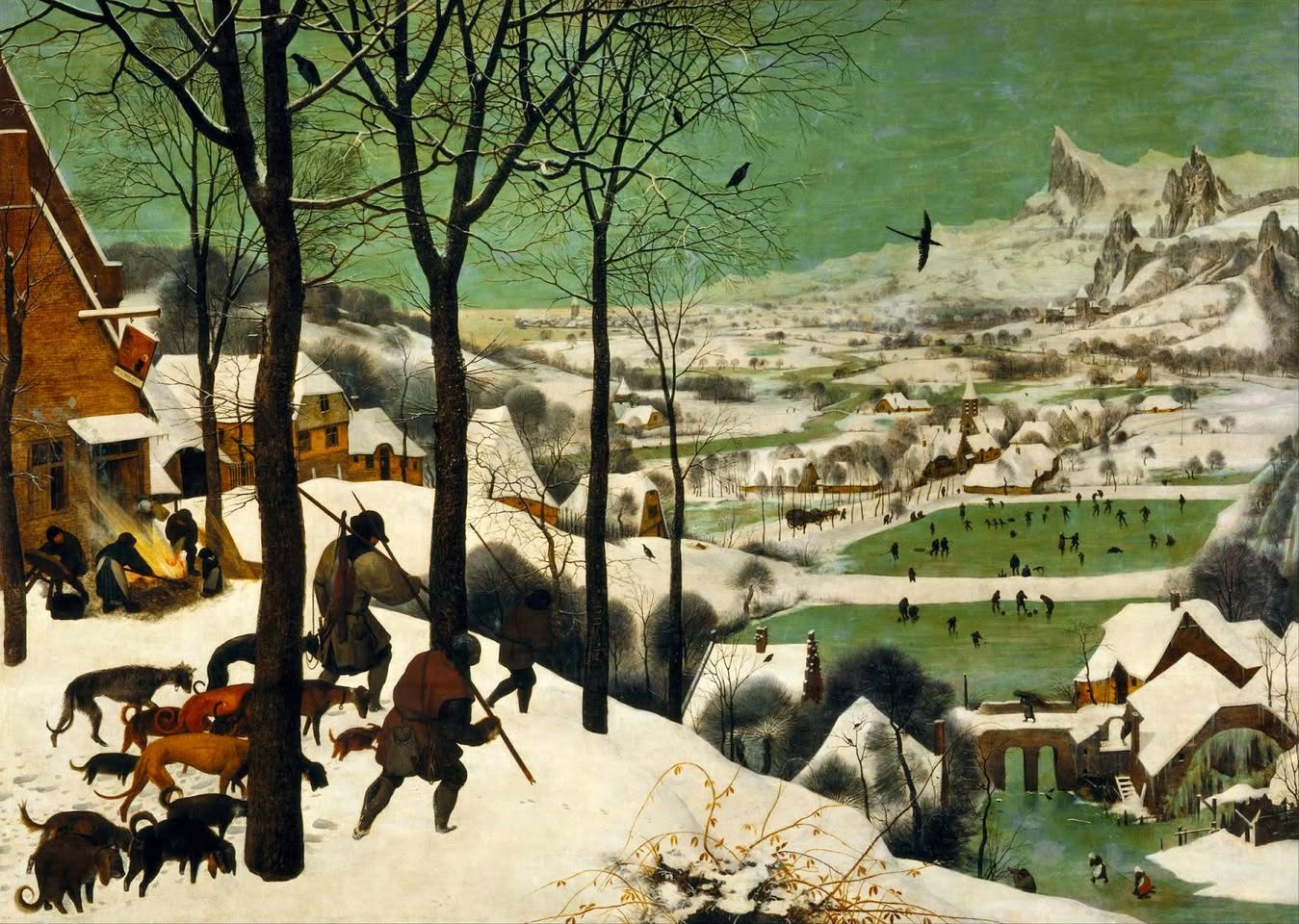
The Hunters in the Snow (1565) - Pieter Bruegel the Elder
'Much of the discussion of film adaptation quietly reinscribes the axiomatic superiority of literary art to film, an assumption derived from a number of superimposed prejudices: seniority, the assumption that a older arts are necessarily better arts; iconophobia, the culturally rooted prejudice (traceable to the Judaic-Muslim-Protestant prohibitions on “graven images” and the Platonic and Neoplatonic depreciation of the world of phenomenal appearance) that visual arts are necessarily inferior to the verbal arts; and logophilia, the converse valorization, characteristic of the “religions of the book,” of the “sacred word” of holy texts. Stucturalist and poststructuralist theoretical developments, meanwhile, indirectly undermine some of these prejudices in ways that have implications for our discussion of adaptation. The structuralist semiotics of the 1960s and 1970s treated all signifying practices as productive of “texts” worthy of the same close attention as literary texts. The Bakhtinian “translinguistic” conception of the author as the orchestrator of preexisting discourses, meanwhile, along with Foucault's downgrading of the author in favor of a pervasive anonymity of discourse, opened the way to a “discursive” and nonoriginary approach to all arts. With poststructuralism the figure of the author, rather like the Robin Williams character in Deconstructing Harry, loses focus and firmness. Derridean deconstruction, meanwhile, by dismantling the hierarchy of “original” and “copy,” suggests that both are caught up in the “original.” And if authors are fissured, fragmented, multidicursive, hardly “present” even to themselves, how can an adaptation communicate the “self-presence” of auhorial intention? In the same vein, Roland Barthe’s provocative leveling of the hierarchy between literary criticism and literature tends, by analogy, to rescue the film adaptation as a form of criticism or “reading” of the novel, one not necessarily subordinate to the source novel.'
Robert Stam, 'The Dialogics of Adaptation', in Film Adaptation, edited by James Neremore, publisher: Rutgers University Press
'The impetuous fury of the entering gust nearly lifted us from our feet. It was, indeed, a tempestuous yet sternly beautiful night, and one wildly singular in its terror and its beauty. A whirlwind had apparently collected its force in our vicinity; for there were frequent and violent alterations in the direction of the wind; and the exceeding density of the clouds (which hung so low as to press upon the turrets of the house) did not prevent our perceiving the lifelike velocity with which they flew careering from all points against each other, without passing away into the distance. I say that even their exceeding density did not prevent our perceiving this—yet we had no glimpse of the moon or stars—nor was there any flashing forth of the lightning. But the under surfaces of the huge masses of agitated vapor, as well as all terrestrial objects immediately around us, were glowing in the unnatural light of a faintly luminous and distinctly visible gaseous exhalation which hung about and enshrouded the mansion.'
Edgar Allan Poe, 'The Fall of House of Usher', in The Fall of House of Usher and Other Stories, publisher: Penguin Books
'Catherine had seasons of gloom and silence now and then: they were respected with sympathizing silence by her husband, who ascribed them to an alteration in her constitution, produced by her perilous illness; as she was never subject to depression of spirits before. The return of sunshine was welcomed by answering sunshine from him. I believe I may assert that they were really in possession of deep and growing happiness. It ended. Well, we must be for ourselves in the long run; the mild and generous are only more justly selfish than the domineering - and it ended when circumstances caused each to feel that the one’s interest was not the chief consideration in the other’s thoughts.'
'Time brought resignation, and a melancholy sweeter than common joy. He recalled her memory with ardent, tender love, and hopeful aspiring to the better world, where, he doubted not, she was gone.'
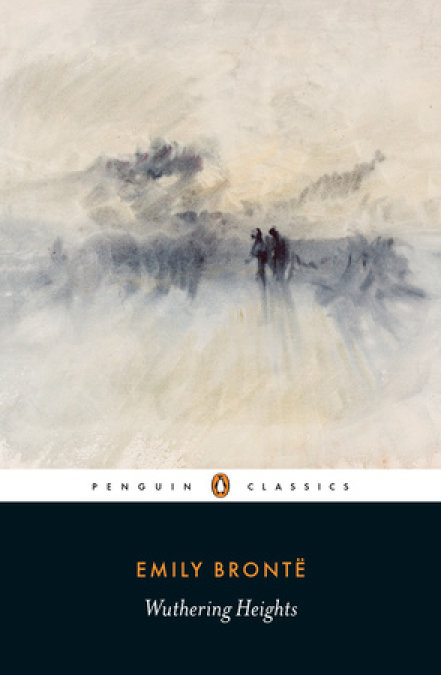
Emily Bronte, Wuthering Heights, publisher: Penguin Books