'While selfies [...] may evince a certain callousness and indifference to behavioral norms, they also reveal an associative realignment. [...] This realignment moves the onus of experience away from phenomenal engagements with adjacent strangers and towards digital interactions with online communities. The former tend to be ruled by pre-established codes of conduct that ensure civility in place of familiarity; the latter rely on more itinerate and fluid systems of mores developed within (or adopted by) online associative networks in the process of formation.
'The fissure between phenomenal experience and digital interaction originates in the translation of the former into the latter. This kind of translation not only involves a system of mediation (disassociation), but also one of transmission, in which the selfie serves as a “real-time” performance of self oriented towards an audience situated elsewhere. This performance, so integral to processes of individuation and identification within groups, is always defined by a spatial and temporal displacement, as well as a separation between the self and the sign (the selfie) that is its surrogate.'
Adam Levin, 'The Selfie in the Age of Digital Recursion', Ecologies, 20
'In the early 1980s, Michel Foucault wrote that in the face of institutional and state violence and of massive ideological pressures, the central question of our time remained 'Who are we?' [...]. Foucault claimed that in previous epochs, the struggle against domination and exploitation had taken center stage. Now, for an increasing number of people, the fight was against subjection, against the submission of subjectivity. According to Foucault, this circumstance called for a rigorous and historicizing interrogation of power as exerted and experienced. Subjectivity - that multilayered construction of selfhood imagined, performed and assigned - was proposed as the current site of struggle that mattered most. The assertion of 'who we are', particularly for a citizenry massively separated from the engines of representation - the advertising, news, and entertainment industries - is a vital expression of agency. We are not only what we do in a world of images; we are also what we show ourselves to be.'
Michael Renov, 'First Person Films: Some Theses on Self-Inscription', in Rethinking Documentary: New Perspectives, New Practises edited by Thomas Austin and Wilma de Jong, publisher: McGraw Hill / Open University Press
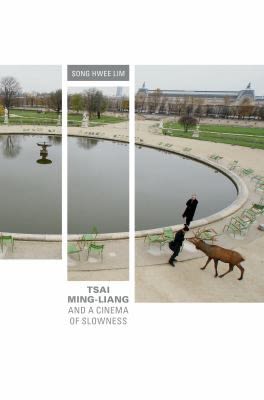
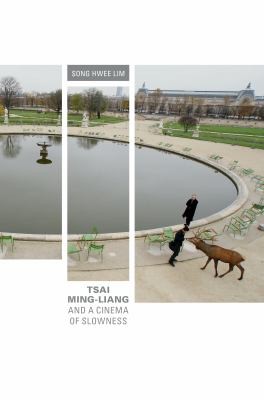
'If myths and memories are the source material for filmmaking, Tsai, like all filmmakers, is first and foremost a mythologist, whose one final possible choice, according to Roland Barthes, is between two equally extreme methods: “either to posit a reality which is entirely permeable to history, and ideologize; or, conversely, to posit a reality which is ultimately impenetrable, irreducible, and, in this, case, poetize” [...]. Tsai’s films, however, demonstrate that the boundary between dreamscape and reality is porous, and that filmmakers can be adept at the tasks of ideologizing and poetizing. Indeed, his cinema of slowness is at once poetry and ideology. For Tsai, dreamscape should not be produced quickly in factory; rather, it should be as unique and distinctive as each person’s fingerprints and signature. Informed by cinephilia, imbued with nostalgia, and signed by an auteur, his cinema of slowness is marked by poetry of stillness and silence [...].'
Song Hwee Lim, Tsai Ming-liang and a Cinema of Slowness, publisher: University of Hawai‘i Press
'Against a clear background, amazed at their own transparency, the faces of Tsaï Ming-liang’s films appear transfixed, born to the streets in a forgotten season where nothing is familiar. Sculpted from some strange substance, they belong to a generation of ashes born by the wind, arriving in the real through the action of foreign forces, foreign bodies; transported by distant, inexplicable energies. They fail to recognize themselves. They examine themselves and each other, but never grow. They search the secret of their mysterious origins in underground conflicts, guided by depressing enigmas. They hope to tell their story in a different way than in submission to the present, to their appearances in each shot to the daily paths. They wish to trace a fold in which to hide halfway, or a line in joining a current of challenges. Control is a distant force for these lost, mistreated, short-winded beings, something that belongs to the rest of the world, to objects, to geometry, to pointless conflicts, their art of sudden awakenings, of unprovoked aggression, of crises without cause, object or even effect, When they can be explained, the answer only appears, finally, as an illusion, a pretext, an accidental creation that sends one back to abstract feelings and their multiple destinations.'
Olivier Joyard, 'Coproral Interference', translated from the French by J. Ames Hodges, in Tsaï Ming-liang edited by Danièle Rivière, publisher: Dis Voir
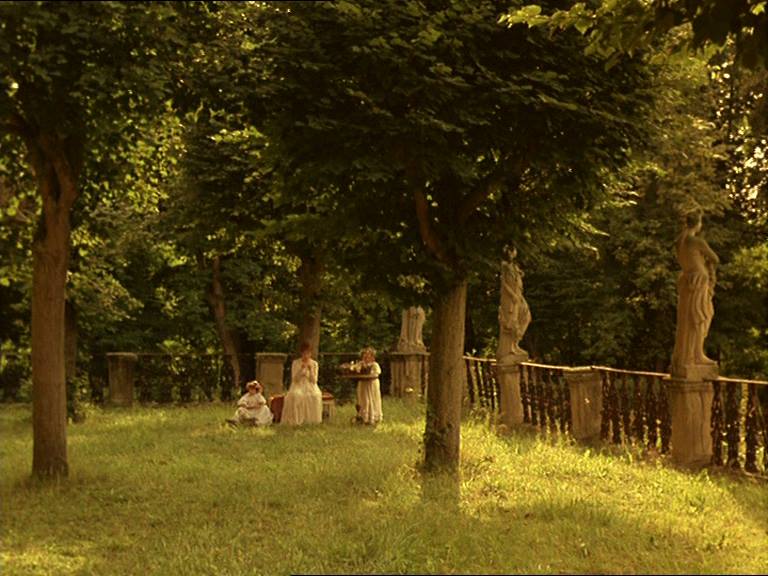
Frame grab from Eric Rohmer’s Die Marquise von O... (1976)