'Taken aslant by language, the world is written through and through; signs, endlessly deferring their foundations, transforming their signifiers into new signifiers, infinetely citing one another, nowhere come to a halt: writing is generalized. If the alienation of society still demands the demystification of languages (and notably the language of myths), the direction this combat must take is not, is no longer, that of critical decipherment but that of evaluation. Faced with all the writings of the world, with the skein of different forms of discourse (didactic, aesthetic, informative, political, etc.), it is a question of estimating levels of reification, degrees of phraseological density. Will we be able to render precise a notion which seems to me essential, that of the compactness of a language? Languages are more or less thick; certain amongst them, the most social, the most mythical, present an unshakeable homogeneity (there is a real force of meaning, a war of meanings): woven with habits and repetitions, with stereotypes, obligatory final clauses and key-words, each constitutes an idiolect, or more exactly a sociolect (a notion to which twenty years ago I gave the name of writing). Thus, rather than myths, it is sociolects which must today be distinguished and described; which means that mythologies would be succeeded by an idiolectory - more formal and thereby, I believe, more penetrating - hose operational cocncepts would no longer be sign, signifier, signified and connotation but citation, reference, stereotype. In this way, thick languages (such as the discourse of myth) could be taken up in the line of a trans-writing of which the text (that we still refer to as "literary"), the antidote of myth, would be the extreme pole or rather the region - airy, light, spaced, open, uncertened, noble and free - where writing spreads itself against the idiolect, at its limit and fighting it. Myth, indeed, must be included in a general theory of language, of writing, of the signifier, and this theory, resting on the formulations of ethnology, psychoanalysis, semiology and ideological analysis must widen its object so as to taken in the sentence or, better, to take in sentences (the plural of the sentence). What I mean by this is that the mythical is present everywhere setenced are turned, stories told (in all the senses of the two expressions): from inner speech to conversation, from newspaper article to political sermon, from novel (if there still are any) to advertising image - all utterances which could be brought together under the Lacanian concept of the imaginary.'
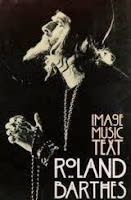
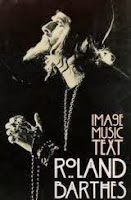
Roland Barthes, Image Music Text, translator: Stephen Heath, publisher: Fontana Press