'The simple sexual act is different from eroticism; the former is found in animal life, whereas human life alone admits of an activity defined perhaps by a “diabolical” aspect, aptly described by the word eroticism. The word “diabolical”, it is true, refers to Christianity. It would appear, however, that even when Christianity was still far off, the most ancient form of humanity knew eroticism. the documents from our prehistory are striking: the first images of man, painted on the walls of caves, show him with his sex erect. there is nothing exactly “diabolical” about these images: they are prehistoric, and the devil in those days, in spite of everything... If it is true that “diabolical” means essentially the coincidence of death and eroticism, and if the devil is in the end only our own madness, if we come to tears, if we shudder in sorrow-or if we are seized by fits of laughter-can we fail to perceive, linked to this nascent eroticism, the preoccupation with, the haunting fear of death (of a tragic death, in a sense, even though laughable in spite of everything)? These people, who in the images the left of themselves on the walls of caves chose to represent themselves most often with an erection, differed from animals not just on account of the desire thereby associated, in principle, with the essence of their being. What we know about them enables us to say that they knew what animals do not know: that they would die.'
'[...] limited to its own domain, eroticism could never have achieved this fundamental truth divulged in religious eroticism, the identity of horror and the religious. Religion in its entirety was founded upon sacrifice. But only an interminable detour allows us to reach that instant where the contraries seem visibly conjoined, where the religious horror disclosed in sacrifice becomes linked to the abyss of eroticism, to the last shuddering tears that eroticism alone can illuminate.'
Georges Bataille, The Tears of Eros, translator: Peter Connor, publisher: City Lights Books
Δάντης, Η Θεία Κωμωδία: Καθαρτήριο, αποσπάσματα από τα Άσματα XI και XVIII, μτφρ. Ανδρέας Ριζιώτης, εκδ. Τυπωθήτω
'Και ποιος είναι ο στόχος της Τζαζ; Η έκφραση της ειδικής σχέσης που έχει ο μουσικός με τα πράγματα. Στην Τζαζ δεν υπάρχει ούτε υπήρξε γενικότητα, τουλάχιστον από την εμφάνιση του Μπίμποπ κι έπειτα. Υπ’ αυτή την έννοια η Τζαζ δεν μπορεί να θεωρηθεί (τουλάχιστον επί του παρόντος) «popular» μουσική. Ακριβώς επειδή πέρα από την μουσική απόλαυση η Τζαζ καταδεικνύει και επισημαίνει με έναν πολύ ιδιαίτερο και ολοκληρωμένο τρόπο, εμπεριέχει άμεση κριτική και στάση τις οποίες και παραδίδει σε κάθε της μουσική κατάθεση. Ο Τζαζμαν, είτε έχει στήσει γλέντι είτε θρηνεί, φανερώνει εκείνη την ειδική σχέση, και είναι η σχέση η οποία διαφεύγει από τους περισσότερους, η σχέση που στερείται η ανθρωπότητα, ένας μουσικός Ενωτισμός.'
Γιάννης Λειβαδάς, 'Round About Jazz, εκδ. Lulu.com
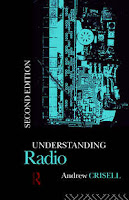
'[...] the distinctiveness of radio is not that it involves the imagination while the other media do not, but that it involves it to a different extent. In literature everything must be imagined since nothing can be seen except printed words, nor can anything be heard. In the visual media many things can be seen and proportionately less is left to the imagination. In radio many things can be heard, and this direct intimation of the material world is perhaps why, in its drama productions at least, its verbal descriptions of a physical setting or of a person's thoughts or appearance are generally much more economical than those of literature and closer to those of theatre, film and television. Moreover the fact that its codes are auditory and therefore exist in time explains the greater sense of 'liveness' that we get from radio 9and the visual media) than we do from literature; for when we start to read a book we know that the last page has already been written. But radio, even when its programmes are pre-recorded, seems to be a "present-tense" medium, offering experiences whose outcome lies in an unknown future. Like theatre, film and television, then, it seems to be an account of what is happening rather than a record of what has happened. But the fact that nothing can be seen on the medium means that the demands which it makes upon the imagination are much greater than those made by the visual media and almost as great as those made by literature.'
Andrew Crissel, Understanding Radio, publisher: Routledge
Λουί Αραγκόν, Το Μουνάκι της Ειρήνης, μτφρ. Ανδρέας Νεοφυτίδης, εκδ. Φόρμα
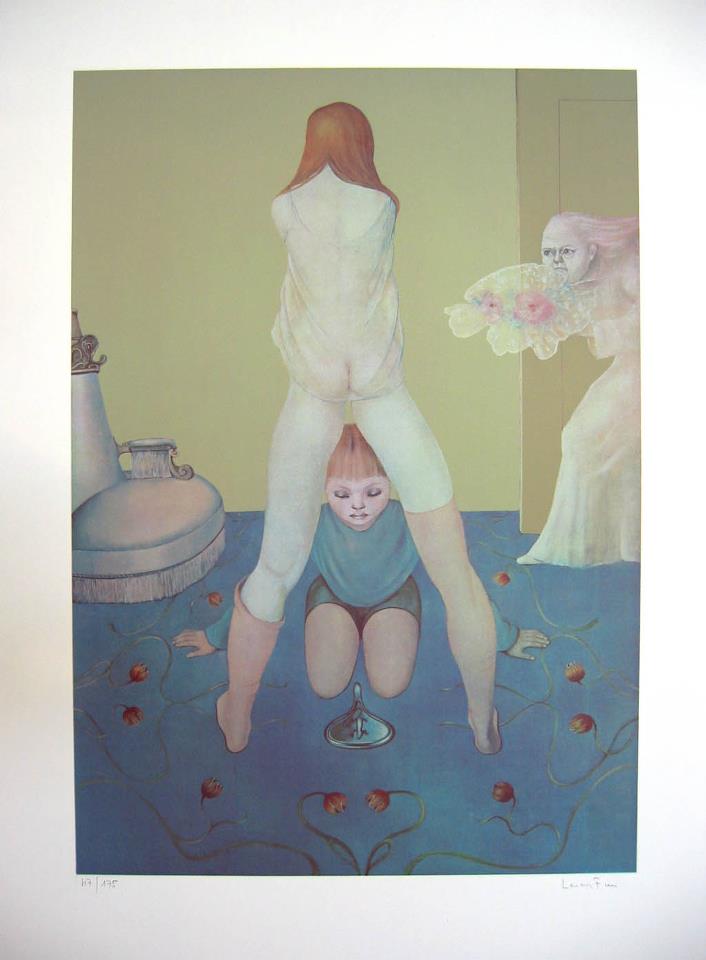
Children’s Game [Kinderstube] (1976) - Leonor Fini
'Entrainment can be reflected in the global environment, architecture, and even in our physiology. An electromagnetic field vibrates between the ionosphere and the Earth’s surface 4-8Hz (called the Schumann resonance), which synnchronizes not only with that theta consciousness state of “oneness” and harmony with the universe, but is also said to be mathematically related to many sacred sites such as Stonehenge and the Pyramids.'
'We seem to be wires for imposing order on our perceptions, as the brain will pull out patterns from chaos even if none objectively exist. Watching a person walk on screen and putting music to that image, it will seem that their steps are in sync with the music, just because we tend toward entraining sound and image. This natural tendency can be manipulated consciously, working in conjunction or in counterpoint - by pulling our organic system to its limits and then breaking into new realities [...].'
'A curious note on the root of the world “belicose”, meaning “warlike”, is that this world also is reflected in “bell” or “to make a loud noise” in Old English, perhaps because at that time the metal cannons were being melted into church bells, and vice versa. Bells symbolize the passage of time, reminding man of his mortality and fragility in the universe, just as war does.'
David Sonnenschein, Sound Design: The Expressive Power of Music, Voice, and Sound Effects in Cinema, publisher: Michael Wiese Productions
'Απ’ τον Ολυμπο ο Δίας μοιράζει πολλά κι απ’ τ’ ανέλπιστα πλήθος οι θεοί ξετελεύουν· όσα πρόσμενες λύση δε βρίσκουν, μα δίνει στ’ αναπάντεχο ο θεός ένα τέρμα.'