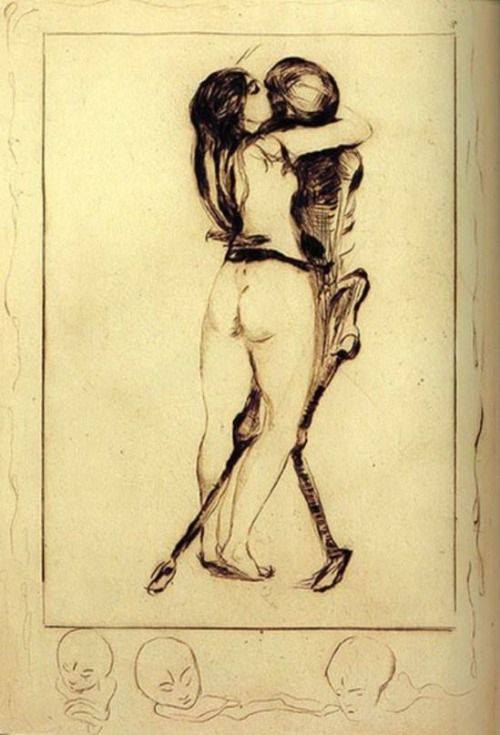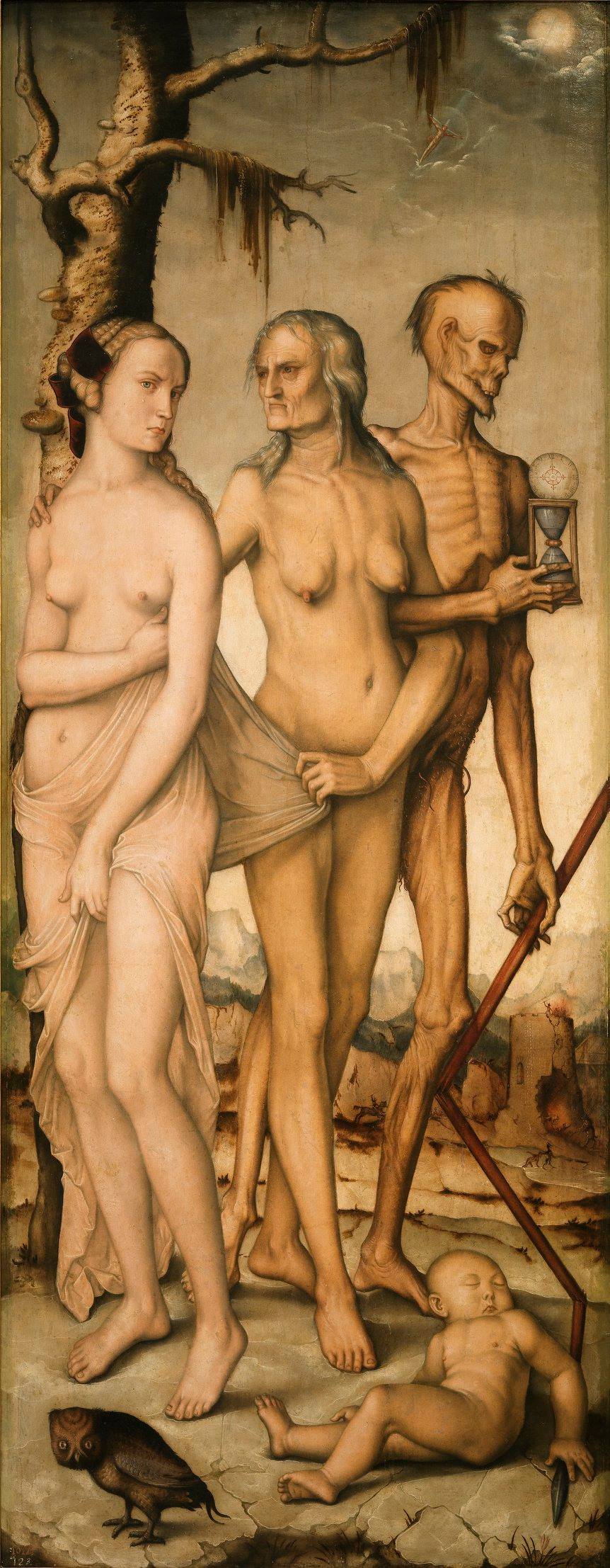
'Blues for Aida' [album: November (2010)] - Steve Lacy

'I see nothing: that is neither visible not sensible in any way one can imagine, nor intelligible. That makes it painful and heavy not to be able to die. . . . Images of ecstasy and betray. What is there has the dimensions of terror, terror makes it come. Such a violent clash is necessary for that to be there. (IE, 122)
Pain and dread—or ecstasy and laughter—even in the absence of anyone who could experience that pain or that ecstasy, give it words and make it his or her own. All the images and ideas are repellent idealizations, impositions of meaning, when in fact there is nothing “I” can see or understand, and no “I” to register such seeing and understanding. Language presupposes intentions, and therefore at least a virtual (grammatical) subject; but the feeling of what is there has no such specificity. Language also posits a degree of universality and interchangeability, since no signification is entirely singular; but the feeling of what is there has no such generality. Affect precedes language, just as it precedes the constitution of a subject. It is the unbearable extremity of passion, and not the alienating intervention of language, which is asubjective and nonintentional. The “interior experience” radically disrupts self presence. The subject seeks ecstasy, seeks to pass out of itself. Yet its existence as a subject can be defined only as its continuing endeavor to preserve itself. And so “il existe un irréductible dé saccord du sujet cherchant l’extase et de l’extase elle-même [there exists an irreducible discord between the subject seeking ecstasy and the ecstasy itself]” (OC, 5:75; IE, 60).
Désaccord (discord), déchirure (laceration), un violent fracas (a violent clash). . . . Not the cogito, but communication. Not self identity and self recognition, but contingency and “improbabilité infinie [infinite improbability]” (OC, 1:89, OC, 5:84; VE, 130, IE, 69) define me. “Car si la plus infime différence était survenue an cours des évé nements successifs dont je suis un terme, à la place de ce moi intégralement avide d'être moi, il y aurait eu ‘un autre’ [For if the tiniest difference had occurred in the course of the successive events of which I am the result, in the place of this me, integrally avid to be me, there would have been ‘an other’]” (OC, 1:89; VE, 130). Nothing is more random, more fragile, more inessential than my “identity.” I am “irreplaceable” precisely because any experience of change is an experience which no longer happens to “me,” in which I am no longer “myself.” Hence the primacy of affect—of a raw, asubjective experiencing of change—over consciousness or language. How reductive of psychoanalysis to reject the notion of unconscious affect, on the grounds that “it is hard to see how the term affect could remain intelligible without some reference to self consciousness” and the ego (Laplanche and Pontalis, The Language of Psycho-Analysis, 14). For if the history of past affects is what makes the singularity of the “me” possible, it is equally apparent that—as long as this history continues—affect cannot coincide with that “me,” or be present to it beyond a certain threshold. Language is a tool of social order, assigning a circumscribed “position” to the self-conscious subject, whereas the violence of affective experience depositions the subject, exceeding its awareness, continually making it other. I become aware of my ecstasy only in retrospect, and even then only “comme la sensation d’un effet venant de dehors. . . . En vérité je suis agi [like the sensation of an effect coming from the outside. . . . In reality, I am acted upon]” (OC, 5:75; IE, 60).'
Steven Shaviro, Passion and Excess: Blanchot, Bataille, and Literary Theory, publisher: University Press of Florida
Luis Buñuel and Andrea Arnold’s approach to Emily Brontë’s Heathcliff
Their intersecting points and differentiations in the adaptation of a literary hero
_________________________________________________________________________________________________________________
Ioannis Tsirkas University of Sussex
The classic Emily Brontë’s novel Wuthering Heights has been adapted in film numerous times –from 1920 to 2011– and in various countries –in America, Mexico, France and Japan among others–. On this paper I will comparatively discuss two cases that are quite distant both in terms of the year when they were produced and the country in which they were filmed. These are Luis Buñuel’s Abismos de Pasión (Mexico, 1953) and Andrea Arnold’s Wuthering Heights (UK, 2011). Although Luis Buñuel was one of the most emblematic auteurs in the history of cinema and the filmic work of Arnold to date is being examined as an auteur’s one by the contemporary film scholars, I will not discuss these films under an auteristic context. In this –short and hence synoptic― essay I will focus on two sequences from each film in reference with the corresponding passages of the novel, by drawing reflections as regards the depiction of the (in)famous character of Heathcliff. The claim of Hila Sachar (2012, p.60) that the depiction of Heathcliff’s character is ‘one of the key aspects through which […] the adaptations engage with their own particular contexts’, could not apply more in these two cases which seem to interpret –and maybe even justify- Heathcliff’s ‘savage physical and emotional brutalities (Kroeber 2006, p.115) in significantly different ways.
In particular, what I will try to explore is the contribution of each film’s two sequences –as narrative figurations of the whole– to the construction of Heathcliff’s character, by examining them comparatively. Specifically, I will examine the sequences that refer to his return a few years after he left Wuthering Heights, and the last ones of each film[1]. Of course, concerning the text of the book itself, the interpretation of the afore-mentioned passages and in general with respect to the representation of Heathcliff can only be objective, if not –especially in my case– idiosyncratic[2]. This is the reason why I will begin my analysis, which will mainly bring into focus what is it narratively depicted and the heroes’ dialogues, with an epitome of what conducive to the forming of Heathcliff’s character is being preceded, illustrative of the way by which I perceive him and therefore constitutes the base onto which the possible differentiations and reconstructions of the two directors will be accounted[3].
Emily Brontë’s Heathcliff
In Emily Brontë’s novel, Heathcliff returns to the Wuthering Heights like an alien force (Drew 1964, p.379), in the same way he had arrived there as a child. However, his return signals his alteration from a simply alien force to an active force of disaster (Cecil 1934, p.165). When Catherine dies, his revenge has not been accomplished but the want of its being fulfilled is on the contrary sharpened. His unamiable disposition, which sometimes seems inexplicable throughout the novel (Miller 1982, p.43), violates the ‘law of reason’ (Bataille 2012, p.16) mainly through his voluntary death, when it appears to be the only thing able to offer him the tranquillity he seeks (Traversi 1970, p.163). His need to be in touch at least with the corpse of Catherine for a last personal moment, and in the end his desire to be near her as a rotting dead body ―in an after death eternity― has no other meaning than his release to the resignation and desolation. By being a figure ultimately cast ‘by pain and grief’ (Carroll 2008, p.254), he vindicates his passion for Catherine by achieving to be buried beside her dead body, demonstrating thus both the dazzle and the out of reach ideal (Eagleton 1988, p.121).
Luis Buñuel’s Heathcliff
In Luis Buñuel’s Abismos de Passion, after the opening credits, a message appears on screen, declaring, among others, that the characters are unique beings on the mercy of their own instincts and passions for which the social conventions do not exist. Also, that Alejandro’s (Jorge Mistral) love for Catalina (Irasema Dilián)[4], being fierce and inhuman, can only be fulfilled through death. The above statement almost forces the spectator’s perception, establishing as main theme of the film the mad love[5] of Alejandro and Catalina, which is driven completely by, as Anthony Fragola (1994, p.55) puts it, the ‘forces of the inner world of instinct and passion’.
When the film begins we watch Isabel complaining to Eduardo about Catalina’s behaviour. In no time, the life of Catalina’s family is being depicted not such harmonious as in the novel, namely because of the ―constructed by Buñuel― otherness of Catalina that makes her more and more associated with Alejandro, justifying thus the ineluctability of their passion. Later, when Eduardo kills a butterfly pinning it for his collection and Isabel tries to deter him by mentioning the animal’s suffering, he responds that this is what keeps it from suffering and that this is the way to keep them [the insects] intact. If we read this dialogue allegorically, we can deduce that what is implied is that only death will stop Catalina and him from suffering and that his passion will be fulfilled through it, since it was the social conventions that undermined it[6].
Thereafter, Catalina comes in and when Eduardo asks her why she has a bird in a cage instead of delivering it from captivity or even killing it, she answers that she does so because she loves it. A statement that has to be read ironically and once again metaphorically. What Eduardo seems unable to understand is that Catalina, being his wife, is also like a bird in a cage, and his love is not a competent reason for this, something that is also confirmed by her addressing to the bird with the words: ‘Enough for you not to mind being locked up, right?’ Consequently, Eduardo’s love is not sufficient for her and thus the coming of Alejandro will have to be perceived as redemptive and nevertheless an even indirect cause of her death. When, later, some dogs are heard barking, Isabel mentions that nothing can scare her, making Catalina to respond that she knows that she will have a short life and that she must like the things that frighten people. If her oncoming death is determined by fate, Alejandro appears less guilty about what he will cause to her ―and, by extension, to all―. In a way, she must like Alejandro whose ‘demonic presence’ (Haire-Sargeant 1999, p.177) scares the majority of the other heroes. Buñuel, as if wanting to confirm us the significance of all the above episodes and dialogues, completely absent in the novel, uses Catalina’s declaration that such misgivings explain many things about her life.
Later on, a rainy night comes and we watch Alejandro approaching the house. When Maria hears his knocking and goes to see who the stranger is, she does really get frightened and immediately tries to shut the door. He prevents her from doing so and then she asks him to leave, rejecting his questions whether she is afraid of the devil inside him or not. In opposition with the novel, Alejandro is not heartily accepted by Maria and after intruding into the house his presence is becoming baleful. Catalina’s enthusiasm when Alejandro finally comes into the living room is apparent and their conversation has an explicit erotic tone, coercing Eduardo to interject them. Finally, before Alejandro leave, he states that the farm of her brother is almost his, a statement that makes Catalina to start laughing joyfully, admiring his aggressiveness and ability to take what he wants and adding that Alejandro loves her more than her husband. All these could only constitute a justification of Heathcliff’s behaviour and accentuate, as Lin Haire-Sargeant (1999, p.175) proposes, his ‘heroic instinctual masculinity’.
Buñuel’s film ends with Ricardo shooting Alejandro into Catalina’s death chamber, a few days after her death. Before this innovation as regards the film’s plot, a dialogue between Ricardo and Isabel, remarkably absent from the novel, is significant about the remarks that have been made about Alejandro’s ‘passion-crazed’ (Evans 1995, p.80) nature. Isabel forebodes that he will go with Catalina and it will be raining upon their dead bodies. Buñuel’s Heathcliff does not wait years after Catalina’s death to lay his corpse beside hers but, knowing that his position is to be with her, he will be the one to choose the ending of his life. Isabel’s declaration confirms that the closure of the myth is predetermined. In this way, when Isabel prevented Ricardo from killing him when he intruded into the house, she almost prefigured his imminent catastrophe. Ricardo, confirming the necessarily necrophyliac catharsis of Alejandro, characteristically adds that he deceives her on Catalina’s tomb with a dead woman.
In fact, in the last sequence we watch Alejandro desecrating the entrance of her death chamber when Ricardo shoots him. Even so, he, wounded ―with the accompaniment of a music that enhances the ‘feverish lyricism’ (Aranda 1975, p.163) of his act― steps down the stairs which lead to her corpse like an Orpheus to Aides in order to meet her in and through his own death. A few moments before the second discharge of the gun, he imagines that besides him is the eidolon of Catalina who proffers her hands to him until he realizes that it is his persecutor who aims him. The transition from her hands to Ricardo’s gun equates Alejandro’s death with a call from Catalina[7]. All in all, Alejandro is presented as nothing more than an Aeschylean hero, unable to change his fate, given to infract the earthly ―especially the socially imposed― laws, determined by his infirmity to escape.
Andrea Arnold’s Heathcliff
Arnold’s film, when it comes to Heathcliff’s (James Howson) return, is much less innovative, remaining close to the book, at least at the way he is represented in the novel’s corresponding passage. In opposition with Buñuel and in accordance with the novel, she presents him as just a victim of the circumstances, but mainly for social reasons rather than metaphysical ones. He is presented, as Amy Martin (2012, p.83) writes, in a ‘subversive way’, but not only as a hero damned by the social order and hence understandable for his actions, but mainly as somebody whose resignation is not redemptive but ineffective. In this way, he is becoming much more sympathetic to us, seconded by the fact that the whole’s film narrative is experienced by his own point of view (Galpin 2014, p.96; Murray 2012, p.57), almost becoming the ‘sole focalizer’ (Pietrzak 2012, p.268) of the film. The above are reflected in the sequence that I will examine now and even better in the film’s ending.
In contrast with Buñuel’s film, when Nelly (Simone Jackson) meets him, although surprised, she does not feel at any rate threatened by his unexpected presence[8]. Heathcliff, although he does not care talking much with Nelly ―since he is obviously eager to meet Cathy (Kaya Scodelario)― is not aggressive and does not give the impression that he is going to disturb the tranquillity of Cathy’s family. In addition, when he meets her their emotions remain unexpressed. None the less, though detached, Heathcliff appears nohow aggressive and rather passive. More importantly, his look does not express unaffected joy when he is talking with her inside the house like in the novel and their conversation is characterized only by restrained and just suggestive expressions of erotic feelings. Finally, though we watch Edgar (James Northcote) calling Cathy back when she goes out with Heathcliff after his leaving, apparently annoyed by his presence, we do not take the impression of his being greatly disturbed or threatened, even if in the novel he is described to be crying from his jealousy.
Both of the films’ narratives end some days after Catherine’s death and now, differentiating her film from the original text, Arnold has the opportunity to connect Heathcliff much more explicitly with necrophilia. Her choices bring on significant results in our perception of Heathcliff’s character and this is what I am going to analyse now. When Heathcliff sneaks into the Thrushcross Grange during the night, he comes in touch with the yet unburied corpse of Cathy. In the novel, the way he farewells Catherine on this point is not described. However, in the film we watch him having possibly sex with her corpse, even reaching a plangent orgasm. But Heathcliff does not die after it, so instead of symbolising an ultimate union, like in Buñuel’s film case or even in the book where ―although many years after Catherine’s death― he demands and gets buried beside her corpse having almost voluntarily died, it functions more as an ineffectual fulfilment of a frustration or, at the very best, an utmost contravention of all the social conventions that made him an outsider. This representation is achieved through the refusal of, some times even spatial, access to his presence. Through this one and only sexual intercourse, in fact the after death access to Cathy’s body, Heathcliff succeeds not a behind time macabre triumph, but a triumphant achievement in the field of an indecisive battle, that it is being attempted unsuccessfully to be expanded here from the social to the metaphysical sphere.
On a later sequence we watch him digging the ground of Cathy’s tomb but, failing to open her coffin, he lets it go. The digging upon her grave does constitute nothing more than a politically incorrect desecration, in any case unmeaning. When in the following scenes he intrudes in the Wuthering Heights and fights with Hindley and Isabella (Nichola Burley), his aggressiveness comes exactly as a result of his continuous struggle to reach what he had been denied since his childhood. He has lost this fight not against his fate but, as a social unit, against his confinement into that point and time. This interpretation is clearly validated by Arnold who ends her film not with Heathcliff’s accomplishment of his objectives, but with the bequest of Hindley’s property to him. By focalising onto the social aspect of his revenge ―he married Lindon’s sister and then he inherited Hindley’s fortune― and connecting additionally his social with his sentimental fate, she ascribes the unobtainable of his passion to reasons eventually explainable and in accordance with the human nature.
Through the almost exclusive occupation with these particular sequences of each film I demonstrated how their differentiation from the original text, as well as between them and their intersecting points, contributed to the construction of Heathcliff’s character ―such problematic and enigmatic as in the book― and evil nature. Apart from the assessment whether each director followed the book’s spirit or not, what was more essential was the way by which they constructed and designated two different characters whose nature reflects the spirit of each film as well. Either an Aeschelyan hero and prey of predetermined callings or an injured wanderer that the social structure has rejected and deprived of love, both characters are based and built on Emily Brontë’s one and only character, proving that the apperception of such a classical literary hero is not ―and could not de facto be― definite.
____________________________________
[1] The choice of these two particular sequences is not of course without reason as, in Buñuel’s film, the first –under examination– sequence is the opening one, while in Arnold’s the first of ―what we can consider as― its second part, in which the occurring events from this point and henceforth are similar to the ones in Buñuel’s film, until the significant differentiations of each ending.
[2] We could say the same about the two directors’ interpretations of the original text, which in their turn can be considered as such.
[3] Here, I have to call to attention that my especial reference at first to the original novel’s text should not be taken as prolegomenon to my main analysis, but as an inextricable part of its content’s canon, since it constitutes a choice of just structural character.
[4] As the film’s story is set in Mexico, the names of the heroes have been changed. Heathcliff’s equivalent is Alejandro and Catherine’s is Catalina, while Isabelle’s, Edgar’s, Nelly and Hindley’s -who are the other four characters of the film to whom I will refer to- are Isabel (Lilia Prado), Eduardo (Ernesto Alonso), Maria (Hortensia Santoveña) and Ricardo (Luis Aceves Castañeda) respectively.
[5] Or the amor fou, if we wanted to use the original surrealistic term of the notion.
[6] As it is also implied at the beginning of the film.
[7] The extended hands are a recurrent motif in Luis Buñuel’s films, an action that always carries latent symbolisms. For a mention of a similar function of this motif in another Buñuel’s film of his Mexican period -which he directed just three years before Abismos de Passion-, Los Olvidados (1950), see -a relative essay of mine- Tsirkas 2013 in the bibliography.
[8] The same applies to Hindley’s (Lee Shaw) reaction earlier in the film.
Bibliography
Aranda, Francisco (1975) Luis Buñuel: A Critical Biography. Translated from Spanish by David Robinson. London: Secker & Warburg.
Bataille, Georges (2012) Literature and Evil. Translated from French by Alastair Hamilton. London: Penguin Books.
Brontë, Emily (2003) Wuthering Heights. London: Penguin Books.
Carroll, Joseph (2008) ‘The Cuckoo’s History: Human Nature in Wuthering Heights’, Philosophy and Literature, 32(2), pp.241-257.
Cecil, David (1934) Early Victorian Novelists: Essays in Revaluation. London: Constable.
Drew, Philip (1964) ‘Charlotte Brontë as a Critic of Wuthering Heights’, Nineteenth Century Fiction, 18(4), pp. 365-381.
Eagleton, Terry (1988) Myths of Power: A Marxist Study of the Brontës. Basingstoke: Macmillan Press.
Evans, Peter William (1995) The Films of Luis Buñuel: Subjectivity of Desire. Oxford: Clarendon Press.
Fragola, Antony (1994) ‘Buñuel’s Re-vision of Wuthering Heights: The Triumph of L’ Amour Fou over Hollywood Romanticism’, Literature/Film Quarterly, 22(1), pp. 50-56.
Galpin, Shelley Anne (2014) ‘Auteurs and Authenticity: Adapting the Brontës in the Twenty-First Century’, Journal of British Cinema and Television, 11(1), pp. 86-100.
Haire-Sargeant, Lin (1999) ‘Sympathy for the Devil: The Problem of Heathcliff in Film Versions of Heathcliff in Film Versions of Wuthering Heights; in Nineteenth Century Women at the Movies: Adapting Classic Women’s Fiction to Film. Bowling Green: Bowling Green State University Press, pp. 167-191.
Kroeber, Karl (2006) Make Believe in Film and Fiction: Visual vs. Verbal Storytelling. Basingstoke: Palgrave Macmillan.
Martin, Amy (2012) ‘A Battle of Two Fronts: Wuthering Heights and Adapting the Adaptations’, in Kathleen Loock and Constantine Verevis (eds.) Film Remakes, Adaptations and Fan Productions: Remake/Remodel. Basingstoke: Palgrave Macmillan, pp. 67-86.
Miller, J. Hillis (1982) Fiction and Repetition: Seven English Novels. Cambridge: Harvard University Press.
Murray, Johnny (2012) ‘Wuthering Heights’, Cineaste, 38(1), pp. 57-8.
Pietrzak-Franger, Monika (2012) ‘Adapting Victorian Novels: The Poetics of Glass in Jane Eyre and Wuthering Heights’, Adaptations, 5(1), pp. 268-73.
Sachar, Hila (2012) Cultural Afterlives and Screen Adaptations of Classic Literature: Wuthering Heights and Company. Basingstoke: Palgrave Macmillan.
Traversi, Derek (1970) ‘Wuthering Heights After a Hundred Years’, in Miriam Allott (ed.) Emily Brontë: Wuthering Heights: A Casebook. London: Macmillan, pp. 157-176.
Tsirkas, Ioannis (2013) ‘The Dream Sequence in Los olvidados as Narrative of the Film's Stochastic Interpretation’, Προγραφές / Proscriptions, 30 June. Available at: http://prografes.blogspot.co.uk/2013/06/800x600-dream-sequence-in-los-olvidados.html (Accessed: 9 November 2014).
Filmography
Abismos de Pasion (1953) Directed by Luis Buñuel. Spain: Films Sans Frontiers.
Wuthering Heights (2011) Directed by Andrea Arnold. UK: Artificial Eye.
Acknowledgment
Ι would like to express my sincere thanks to Christos Aggelakopoulos for his diligent philological support.


'In The Rule of the Metaphor philosopher Paul Ricoeur writes: “If there is a point in our experience where living expression states living existence, it is where our movement up the entropic slope of language encounters the movement by which we come back this side of the distinctions between actuality, action, production, motion” [...]. Clearly, [...] ambivalent articulations of the sensual experience of the lived body in relation to cinematic representation mark just such a point. I want, therefore, to consider the ambivalence and confusion of our sense at the movies of having both a “real” (or literal) sensual experience and an “as-if-real” (or figural) sensual experience. I also want to argue that this ambivalence has a precise phenomenological structure that is grounded in the nonhierarchical reciprocity and figure-ground reversibility of “having sense” and “making sense”—meaning thus constituted as both a carnal matter and a conscious meaning that emerge simultaneously (if in various ratios) from the single system of flesh and consciousness that is the lived body. This is another way of saying that the body and language (whether film language or “natural” language) do not simply oppose or reflect each other. Rather, they more radically in-form each other in a fundamentally nonhierarchical and reversible relationship that, in certain circumstances, manifests itself as a vacillating, ambivalent, often ambiguously undifferentiated, and thus “unnameable or “undecidable” experience.'
Vivian Sobchack, Carnal Thoughts: Embodiment and Moving Image Culture, publisher: University of California Press
'The silence at the moment of execution and for a moment or two continuing thereafter, a silence but emphasized by the regular wash of the sea against the hull or the flutter of a sail caused by the helmsman’s eyes being tempted astray, this emphasized silence was gradually disturbed by a sound not easily to be verbally rendered. Whoever has heard the freshet-wave of a torrent suddenly swelled by pouring showers in tropical mountains, showers not shared by the plain; whoever has heard the first muffled murmur of its sloping advance through precipitous woods, may form some conception of the sound now heard. The seeming remoteness of its source was because of its murmurous indistinctness since it came from close-by, even from the men massed on the ship’s open deck. Being inarticulate, it was dubious in significance further than it seemed to indicate some capricious revulsion of thought or feeling such as mobs ashore are liable to, in the present instance possibly implying a sullen revocation on the men’s part of their involuntary echoing of Billy’s benediction.'
'The details of this closing formality it needs not to give. But when the tilted plank let slide its freight into the sea, a second strange human murmur was heard, blended now with another inarticulate sound proceeding from certain larger sea-fowl, whose attention having been attracted by the peculiar commotion in the water resulting from the heavy sloped dive of the shotted hammock into the sea, flew screaming to the spot. So near the hull did they come, that the stridor or bony creak of their gaunt double-jointed pinions was audible. As the ship under light airs passed on, leaving the burial-spot astern, they still kept circling it low down with the moving shadow of their outstretched wings and the croaked requiem of their cries.'
Herman Melville, 'Billy Budd, Sailor (An Inside Narrative)', in Billy Budd, Sailor and Selected Stories, publisher: Oxford University Press

'There is no story, which is also to say: there is no perspective center, only a great continuum made of the conjunction of the two modes of expectation, a continuum of modifications that are miniscule in comparison to normal, repetitive movement. The task of the filmmaker is to construct a certain number of scenes that allow for the texture of this continuum to be felt and that bring the play of the two kinds of expectation to a maximum of intensity. The sequence shot is the basic unity of this construction because it is that which respects the nature of the continuum, the nature of the lived duration in which expectations come together or fall apart, and in which they bring together and oppose beings. If there is no center, there is no other means of approaching the truth of situations, and of those who live them, than this movement that ceaselessly goes from a place to the one who awaits something there. There is no other means than finding the right rhythm for making the rounds of all the elements composing the scenery of a place, and for giving them their suffocating power or their dream-like virtuality: the bareness of a room or the columns and partitions that punctuate it, the leprosy of the walls or the brilliance of the glasses, the brutality of the neon lights or the dancing flames of the stove, the rain that blinds the windows or the light of a mirror. Béla Tarr insists: if montage, as a distinct activity, has so little importance in his films, this is because it takes place in the heart of the sequence, which never ceases to vary in its own interior: in a single shot, the camera passes from a close-up of a stove or a fan to the complexity of the interactions for which a bistro serves as theater; it climbs from a hand toward a face before leaving the latter to enlarge the frame, or to explore other faces; it passes though zones of darkness before illuminating other bodies, now caught on a different level. In this manner it establishes an infinity of miniscule variations between movement and immobility: tracking shots that advance very slowly toward a face, or initially unperceived halts in the movement.'
Jacques Rancière, Bela Tarr, the Time After, translator: Erik Beranek, publisher: Univocal