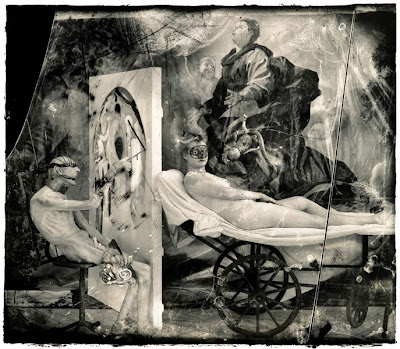
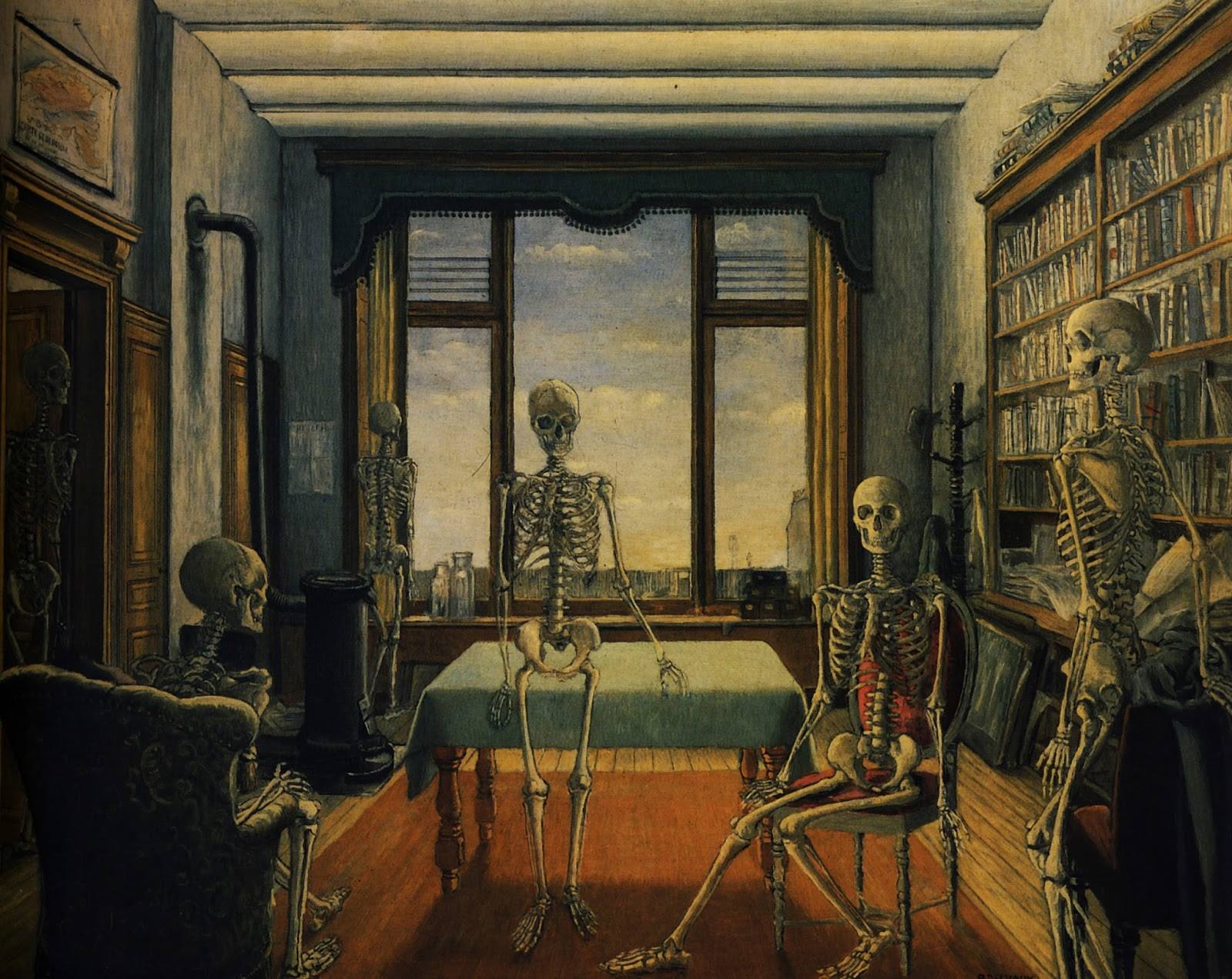
Frame grab from Marco Ferreri’s Tales of Ordinary Madness (1981)

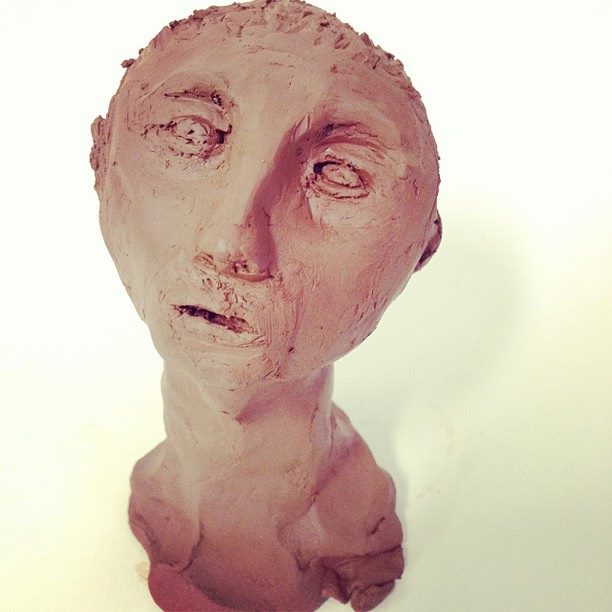
'If the plastic arts were put under psychoanalysis, the practice of embalming the dead might turn out to be a fundamental factor in their creation. The process might reveal that at the origin of painting and sculpture there lies a mummy complex. The religion of ancient Egypt, aimed against death, saw survival as depending on the continued existence of the corporeal body. Thus, by providing a defense against the passage of time it satisfied a basic psychological need in man, for death is but the victory of time. To preserve, artificially, his bodily appearance is to snatch it from the flow of time, to stow it away neatly, so to speak, in the hold of life. It was natural, therefore, to keep up appearances in the face of the reality of death by preserving flesh and bone. The first Egyptian statue, then, was a mummy, tanned and petrified in sodium. But pyramids and labyrinthine corridors offered no certain guarantee against ultimate pillage.
Other forms of insurance were therefore sought. So, near the sarcophagus, along- side the corn that was to feed the dead, the Egyptians placed terra cotta statuettes, as substitute mummies which might replace the bodies if these were destroyed. It is this religious use, then, that lays bare the primordial function of statuary, namely, the preservation of life by a representation of life. Another manifestation of the same kind of thing is the arrow-pierced clay bear to be found in prehistoric caves, a magic identity-substitute for the living animal, that will ensure a successful hunt. The evolution, side by side, of art and civilization has relieved the plastic arts of their magic role. Louis XIV did not have himself embalmed. He was content to survive in his portrait by Le Brun. Civilization cannot, however, entirely cast out the body of time. It can only sublimate our concern with it to the level of rational thinking. No one believes any longer in the ontological identity of model and image, but all are agreed that the image helps us to remember the subject and to preserve him from a second spiritual death. Today the making of images no longer shares an anthropocentric, utilitarian purpose. It is no longer a question of survival after death, but of a larger concept, the creation of an ideal world in the likeness of the real, with its own temporal destiny. “How vain a thing is painting” if underneath our fond admiration for its works we do not discern man’s primitive need to have the last word in the argument with death by means of the form that endures. If the history of the plastic arts is less a matter of their aesthetic than of their psychology then it will be seen to be essentially the story of resemblance, or, if you will, of realism.'
André Bazin, What Is Cinema? Volume 1, translator: Hugh Gray, publisher: University of California Press
'Time to Go Now' [album: Early October (1995)] - The British Saxophone Quartet
'Sun Love' [album: Jazz Meets India (1967)] -
Dewan Motivar Trio / Irene Schweizer Trio / Manfred Schoof / Barney Wilen

What about Monk?
Now mysteriously retired, after more than 3 decades of activity, Monk was the searchlight (beacon) for the bebop revolution. His house and piano were headquarters for the bebop revolution. His house and piano were headquarters for Bird, Diz, Bud, Klook, and all the others, including later disciples like Randy Weston, Coltrane, even myself.
Born and raised in New York, all of Monk’s music is about the city and its varied people and situations. The school of Ellington: Harlem, Broadway, Lucky Millinder, Cootie Williams, Coleman Hawkins, countless others, the influence of Tatum, school of Fats Waller, James P. Johnson, way back to early roots, all intact and growing with each experience.
Small groups, big bands, dancers, singers, shows, solos, information for a developing talent. Monk has always gone his own way, and always knew what was going on.
Some characteristics: mathematics, acoustic sensibility, the ability to see where the music is. Perfect swing, power and concentration. An unparalleled grasp of the "mise en place," and total control of the timeseat in the rhythm section space, at home within (inside) the beat.
Thelonious had the necessary means to carve space, using certain plastic discoveries, painstakingly worked out over a long period of time, on the piano. This music was elaborated and shaped into certain working structures, so as to have something to play, something to play on. These pieces were deliberately made, so as to "trip-up" advanced players into extending their musical capabilities and venturing into new territories. Anyone who ever worked with Monk learned a great deal, and improved their musicianship, taste, and imagination.
I saw this happen with John Coltrane, in New York (’58-59), at the Five Spot Club, in quartet with T.M. At first clumsiness, then awakening, pursuit, doubt, courage, perseverance, penetration, revelation, transcendence. The whole process gone through in 6 weeks! For me, it was unforgettable.
Later ('60), when I worked with the quintet (Charlie Rouse, Roy Haynes, John Ore), Monk opened up new worlds to me, also on a personal, ethical and political plane. He showed me what not to do, and left the rest up to me! Years later, I began to understand. The main thing he showed me was to stick to the point, the point being, to "lift the bandstand!"
Steve Lacy
(Paris, 27 Sept. '80)
from Steve Lacy: Conversations, publisher: Duke University Press